

Talking about homes and property values is something of a pastime in the UK. Property is probably among one of the largest assets we own, so it’s not surprising that we want the value to go up.
Whether you’re hoping to sell your home soon, it’s part of your long-term financial plan, or you simply want to make improvements to benefit your lifestyle, your home’s value may be something you’re thinking about. If you’ve been inspired by the huge number of property TV shows to take on a project, it could increase your property’s worth.
The rise and rise of property values
While there have been times when property values have stagnated or fallen, they’ve overwhelmingly increased.
According to Land Registry data, the average home at the end of 1980 was £20,897. Fast forward four decades and the average price of a home is now £251,500. That’s an increase of more than 1,000%.
As the graph below shows, there have been dips in value, most notably following the 2008 financial crisis. But prices have recovered. Much like when investing in the stock market, a long-term focus is important if you’re weighing up the value of your home or other properties.
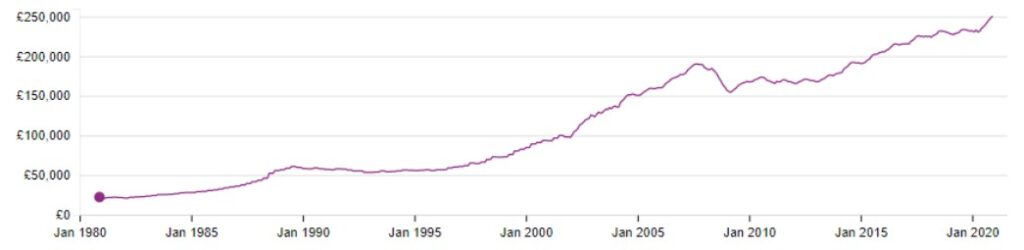
Source: Land Registry
How does your property compare to the graph above? Even if you’ve purchased the home relatively recently, you’ve likely made a profit on your investment. If you want to give it a boost though, there are things you can do.
DIY: A British passion
Going hand in hand with our obsession with property values is a love for DIY. And the lockdowns due to Covid-19 mean we’re spending more time and money on updating our homes than ever.
The average household spent £2,608 on home improvements in 2020, according to Checkatrade. That’s £338 more than in 2019. With most people spending more time at home, investing to make them more comfortable and suit lifestyles was a common goal in 2020. Reflecting changing lifestyles and social distancing, gardens (43%) and home offices (21%) saw the biggest percentage increase in money spent.
Last year also saw a rise in the number of homeowners experimenting and putting their stamp on properties. Extra time spent at home means home improvement enthusiasts were inspired to create new spaces. According to the research, the top new spaces to invest in were:
- Shed office
- Home cinema
- Snug
- At-home bar/pub
- Kids’ jungle gym
It’s time and effort that’s paying off for many – more than half (54%) of Brits love their home more now than ever before. Yet, with 79% still thinking there’s room for improvement, DIY and home renovation projects are likely to continue growing in popularity.
10 projects that could increase the value of your home
If you want to make home improvements and see the value of your property rise, where should you focus? These ten options could be a good place to start.
Remember
If increasing property value is your main aim, keep an eye on local property values. There will be a price ceiling and, in some cases, investing in home improvement projects will have little impact on what the property will sell for.
1. Turn your loft into a living space
Your loft is often wasted space that could be put to better use. While the costs can be large, the value it adds to your home and the additional floor space it provides means it can be a worthwhile investment. How much a loft space will add to your home will depend on a variety of factors, but a general guideline is between 10-20%. If you’re thinking about taking on a loft conversion project to add value, you should carefully weigh up the cost with the expected gains.
A loft conversion can be preferable to an extension as you don’t usually need to apply for planning permission unless you plan to extend or alter the roof space. However, you should ensure you comply with building regulations.
Lofts are often used as storage space so be sure to include storage options or alternative spaces when planning this project. A lack of storage space could put off potential buyers if you plan to sell.
2. Add floor space to your home with an extension
If adding more living space to your home is a goal and you have the land, an extension can be attractive. It’s a significant project to take on though, and you should consider the costs, including unexpected ones that could crop up.
Of course, the cost of an extension varies widely depending on the complexity of the project and materials used. As a general rule, a basic singlestorey addition will begin at around £1,200 per m2, but this can easily double for more complex projects. Extra floor space can add between 5% and 15% to the property’s value, so you’ll need to carefully weigh up your plans with market demand if adding value is central to your plans.
It’s important to think about what the extension will be used for as well, so don’t just focus on the additional floor space. If your property has a small kitchen, for example, extending this space can add far more value than adding a small sitting room. Equally, a poorly constructed or unusable space could reduce your home’s value.
Remember, you will need to get planning permission to build an extension.
Odds or evens?
The number of your home could have a surprising impact on the value of your property. Oddnumbered houses fetch, on average, up to £538 more than even-numbered houses. Unless it’s unlucky number 13, which could see the value fall.
Source: Telegraph
3. Install a new kitchen
The kitchen is the heart of a home. It’s where you may entertain friends or gather with family to chat.
Renovating a kitchen can be costly, but it’s also a focal point for potential sellers. A new kitchen can work wonders when it comes to increasing property prices. Once again, you can install a new kitchen on a budget or splash out with the latest smart technology. If you plan to update appliances, an average kitchen will cost around £8,000. In return for that investment, the value of your home could increase by more than 5%.
If you don’t want to spend money on a full kitchen renovation, smaller projects can still have an impact. Updating or painting kitchen cabinets can give your existing space a whole new lease of life. If your kitchen looks dated, fresh paint and new tiles can also help make it appear far more modern.
When taking on a kitchen project to increase the value for a sale, keep it neutral. A kitchen that appeals to more potential sellers means you’re more likely to benefit from the investment you’ve made.
The “Waitrose Effect”
How close is the nearest supermarket? Easy access to grocery shops can increases prices. Waitrose, Marks & Spencer, and Sainsbury’s deliver the biggest increases.
4. Update your bathroom
Much like the kitchen, a bathroom update can be expensive. As a result, a new bathroom suite can make your home far more attractive for those looking for a property that they can move straight into with minimal effort.
A brand-new bathroom can cost between £2,000 and £6,000, depending on the fixtures you want, but it could boost the property value by 6%.
If your home already boasts a modern bathroom, adding a second bathroom or en suite could appeal to families and add a selling point to your listing. Keep in mind the space you’ll be converting, though – losing a bedroom in favour of a bathroom is likely to reduce the value. Likewise, adding an en suite could make your master bedroom smaller, with no space for wardrobes.
5. Give your garden some love
It’s not all about your home’s interior; your garden and how it appears from the street matters too.
In fact, failing to maintain your garden could knock 5% off the value. Following lockdown due to Covid-19, outdoor spaces in our homes have become more important than ever. Spending some time outdoors tidying it up, creating spaces to relax or entertain, and adding plants can influence your property’s value.
If you don’t enjoy gardening or want to sell your home, opt for a low maintenance project. Adding a few plant pots to a patio area can still add flashes of colour to brighten up a garden while being perfect for beginners.
As well as the garden, inspect your home from in front, as this will be the first impression potential buyers will get. Could your front door do with a clean? Do weeds need clearing from the drive? These small tasks can help buyers envision your home as one they’d like to move into.
This is often an option for boosting the value of your home for relatively little investment, though you will need to be prepared to spend time on it.
What’s in a name?
You probably don’t give too much thought to the name of your street, but if you live on a “Warren”, your home’s value is likely to be double the national average. Living on a “Chase”, “Mount”, “Path” or “Park” also suggests your home will be worth more than the average.
Source: Zoopla
6. Spend some time on cosmetic redecoration
Adding value to your home doesn’t mean you have to take on a huge project or pay for professionals. Sometimes a simple cosmetic uplift is all that’s needed.
Try to look at your home through the eyes of a viewer. Those scuffs on the wall that you overlook can be remedied with a tin of paint and a bit of time. A leaky tap or creaky door are also easy fixes that can give your home a more polished look that will push up the price. It might not have the same effect on the asking prices as a new extension, for example, but cosmetic redecoration can have a real impact.
Focus on the jobs you’ve been meaning to get around to, but simply haven’t found the time for. Where you plan to update the look, keeping it neutral may appeal to a wider range of people.
7. Reflect the work-from-home shift with an office
Does your property have the space to add a home office? With more people than ever working from home in some way, it’s becoming a sought-after addition to a home and could boost the value. From changing a room in your home to an office to building an office in the garden, there are plenty of different options here.
Think carefully before converting space into an office. Converting an additional bedroom into an office space could reduce the value of your home or make it less attractive to young families, for example. Having spaces that can be adapted to suit the needs of homeowners is a good idea.
Check your connections
Easy access to public transport can make your property more appealing, especially to commuters. If you have excellent connections to a bus network, train station, or tube, make it part of your sale listing.
8. Increasing natural light to show off your property
Natural light has a huge impact on how appealing rooms are. Likewise, dark and gloomy rooms can be a deal-breaker for some prospective homeowners.
The obvious way to increase natural light is installing additional windows or making existing ones larger. In some cases, that might not be possible or cost-effective, plus the aspect of your house will also play a role. But there are some smaller steps you can take to maximise natural light. If you have a room that you’d like to brighten up, you could:
- Opt for lighter, brighter interior paints
- Paint the eaves outside your home
- Select paints or surfaces with a high-gloss finish
• Choose reflective tiles for your kitchen or bathroom.
9. Install green money-saving measures
“Green living” is becoming more popular, and it could save you money on bills in the long run. If you’re looking to sell your home, green features could make it more attractive to prospective buyers. Whether you add insulation or update windows to triple glazing, these measures can also make your home more comfortable.
The good news is government support can drastically cut the cost of making these improvements to your home. Under the Green Homes Grant, you could receive a voucher for up to two-thirds of the cost of qualifying improvements up to the value of £5,000. If you or a member of your household qualifies for means-tested benefits, the government may cover 100% of the cost. It’s well worth investigating how you could benefit from the scheme.
10. Create flexible living spaces
Open-plan living spaces have become popular over the last decade, allowing families to spend time together. However, Covid-19 has dimmed some of the appeal. According to John Lewis, open-plan layouts are being swapped for modular options, allowing family members to have some privacy and space.
The shift isn’t too surprising when you consider that many people have been juggling working from home and homeschooling with usual household activities. One in five homeowners have reconfigured open-plan spaces to accommodate multiple activities. If you have an open-plan living space, thinking about how it can be divided to create separate spaces for different needs could boost your home’s value.
Search Ofsted reports
Local schools will make a huge difference to a property’s value. A nearby school rated “good” or “outstanding” can make an area more attractive to families and so boost the value of your property
Ready to start your home improvements?
If you’re ready to undertake a home renovation project, how you’ll finance it is important. A financial planner can help you understand where to take money from with your long-term goals in mind, whether that’s your investments, pension, or even borrowing the money.
In some cases, you may also want to borrow more through your mortgage. Working with a mortgage broker can help you find the right deal for you, and could even save you money.
To discuss your plans, please contact us.
