

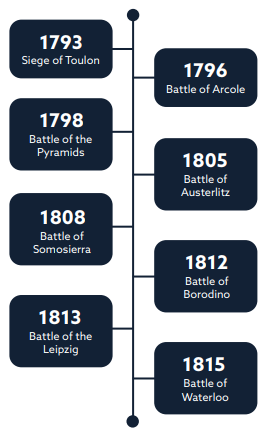
In 1793, a vast army of the French First Republic locked horns with a combined force of Royalists and their foreign allies at the port city of Toulon. It was in this battle that a young artillery officer caught the attention of his superiors, demonstrating not only a high level of organisational skill, but also tactical brilliance and the charisma needed to inspire his men.
This officer was, of course, Napoleon Bonaparte and the Siege of Toulon would be the first major stepping stone in his long and glorious career. In only 11 short years, he would rise from the rank of a humble captain to being the Emperor of the French.
Napoleon was undeniably a brilliant strategist and organiser, bringing about a variety of changes to the armed forces and government. His legal reforms, the Napoleonic Code of 1804, form the basis of private law systems for a variety of countries in the modern day.
As such, there are many lessons that can be learned from his innovative and dynamic style of leadership – even when it comes to growing your wealth.
1. Having reserves can protect you against unexpected shocks
In life, you never know when the unexpected might happen, at least not without the aid of a crystal ball. If you encounter a sudden financial shock, it might seriously disrupt your progress towards your goals.
This is where having an emergency fund of cash can help you, as it can act as a useful buffer. The importance of keeping these necessary reserves is one of the most important lessons Napoleon learned in his campaigns.
During the Revolutionary Wars, the French Republic found itself with its back against the wall. It had enemies on all sides and not nearly enough soldiers to fight them all.
In order to raise the much-needed manpower, it implemented the levée en masse, a form of national conscription. The only problem was that these conscripts weren’t exactly thrilled to go into battle, and so it could be difficult to keep them in order when the cannonballs started flying.
In case these new and poorly-motivated soldiers faltered, Napoleon knew he had to keep strong reserves. This led to the creation of the Imperial Guard in 1804, who quickly became a useful backbone of his armies and could be relied upon in a pinch.
For example, if a portion of his front line was faltering, which could result in an enemy breakthrough, Napoleon could quickly redirect some of his Imperial Guard to plug the gap. This helped prevent a minor problem from turning into a major one.
It’s likely that at some point in your working life that you’ll experience some sort of short-term disruption to your life plans. You might be made redundant or have to pay an unexpectedly large bill.
When this shock happens, it can be important to have a reserve of easily accessible cash to help you ride it out.
According to a recent study in International Adviser, 51% of UK households don’t have enough emergency savings.
Keeping an emergency fund can be a useful way to gain more financial stability, as it can act as a buffer against the unexpected. This can also help you to avoid relying too heavily on credit if you’re unable to work for a period of time.
Typically, most experts recommend that you should keep enough in your emergency fund to cover around three to six months’ worth of expenses. Of course, you may want to consider keeping a larger reserve if you are self-employed or work in a field that is particularly at risk.
Keeping this fund can be a great way to gain more peace of mind, knowing that even if the unexpected should happen, you’ll be able to keep paying your bills until you get back on your feet.
Of course, while having this reserve can be very useful, it’s also important not to keep too much of your wealth in cash, due to the risk of inflation eating away its true value.
2. Keep an eye on inflation
As you may know, inflation is effectively a decrease in the buying power of your money over time. It is for this reason why it may not be in your best interests to keep too much of your wealth in cash.
While changes in inflation may seem small, they can add up significantly over time and have a serious impact on your financial well-being. This is one of the lessons that Napoleon learned during his time as emperor.
In the years prior to the French Revolution, the government had accrued significant debts, which reached more than 950 million livres by late 1789. To help pay these off, they also started to print assignats, which were essentially a type of government bond. Each one would be worth 1,000 livres and would pay 5% annual interest.
Initially, this move helped to raise significant funds and stave off bankruptcy. However, problems began to arise when some politicians lobbied to have the assignats be considered as legal tender. This was due to a lack of physical money, like coins.
However, as the government printed more and more to pay their debts, the value of this new currency fell through the floor.
The resulting inflation made basic commodities like food and rent more expensive for normal people. This drove up the cost of living for many citizens, as their wages hadn’t increased with the change in prices.
As you might imagine, the rising inflation led to a considerable amount of anger and unrest.
The Bank of England has a target of 2% inflation. If they don’t meet it, the governor has to write to the chancellor of the exchequer to explain why.
To remedy this, Napoleon had to reconsider the government’s approach towards its finances. He reimplemented the gold standard and began to mint new coins made from precious metals in order to stabilise the price of goods.
While you probably won’t have to worry about inflation destabilising your community, it can still have a significant impact on your finances.
Inflation erodes the buying power of your money and over time can eat into its true value. If you hold a portion of your wealth in cash, and the interest rate on your account is lower than the rate of inflation, you are essentially losing out in real terms.
If you want to avoid this, keep an eye on changes in the rate of inflation and change your financial strategy accordingly. For example, you may want to consider investing wealth rather than holding it in cash. If you are already investing, you may want to reconsider your risk tolerance. The Bank of England has a target of 2% inflation. If they don’t meet it, the governor has to write to the chancellor of the exchequer to explain why.
According to the Bank of England’s inflation calculator, to buy the equivalent of £10,000 worth of goods in 1990 today it would cost you around £23,244.
“If the art of war were nothing but the art of avoiding risks, glory would become the prey of mediocre minds… I have made all the calculations; fate will do the rest.” – Napoleon Bonaparte
3. Understand your attitude to risk
When it comes to investing, there is almost always an element of risk. However, the trick to growing your wealth effectively involves knowing how much you’re willing to expose yourself to.
Throughout his campaigns, Napoleon always had to know when to take his chances with a bold move and when to play it safe. Knowing how much risk he was willing to tolerate was an important part of his strategy.
When Napoleon fought in Italy in the 1790s, he was significantly outnumbered by the Austrian and Italian armies. One of the biggest resulting innovations was his idea of “defeat in detail” and he would use this strategy throughout his career.
Essentially, this plan involved splitting up the main body of his army into smaller groups and moving them separately.
For example, if he had 15,000 men, while his enemy had 20,000, he might split his forces into five smaller groups of 3,000 each. His opponent would then be forced to do the same, with five groups of 4,000.
Then, as he approached an enemy army, he would consolidate nearby forces to achieve local numerical superiority, giving him the advantage.
Of course, this strategy was very risky since if the Austrians and Italians had attacked one of his isolated armies, they would have held a significant advantage in numbers. However, given the situation, it was necessary to take some risk to win his victories.
According to a recent study, the pandemic has made one-third of investors more hesitant to take risks.
If you want to grow your wealth effectively, it’s important to think about risk. As you will know, all investments have some degree of risk, which is why it’s important to understand how much you’re willing to tolerate to reach your goals.
When it comes to working out how much risk you’re prepared to accept, there are two major factors to consider.
Your investing goals
When thinking about your investing strategy, it’s important to know what you’re investing for, as this will dictate how much you’ll need your wealth to grow by. For example, saving for a comfortable retirement is likely to require more money than affording a mortgage deposit.
Your time horizon
The second factor that can influence your attitude to risk is how long you plan to invest for, also known as your “time horizon”. If you’re planning to grow your wealth over a longer period, you may be able to afford to take more risks, as the general upward trend of the market should smooth over any temporary falls.
Of course, if you want to thoroughly protect your wealth from unexpected financial disruptions, you may benefit from diversifying your portfolio.
4. Keep a diverse array of assets
When investing your wealth, it can often be useful not to put all your eggs into one basket. This is because if you only invest in one particular sector or asset class, and it suffers a fall, you could lose a lot of money very quickly.
Instead, it is often better to diversify your portfolio to make it more resilient to shocks. Keeping a wide variety of strategic assets is one of the factors that made Napoleon such an adaptable leader, as he had troops for every scenario.
While the vast bulk of his armies were made up of standard infantry trained to fight in lines, they also included many specialists.
For example, if he needed to harass the enemy and screen his forces from scouting cavalry, he could rely on his companies of voltigeurs. These were light infantry, who were trained to fight as individuals, moving as they saw fit and sniping at their foes from behind cover.
Conversely, if he needed to smash through a weak point in the enemy line, or breach a fortification, he would send in his grenadiers. These shock troops were tall and burly men who were experts at close-quarter fighting.
As with the infantry, Napoleon’s much-vaunted cavalry forces likewise contained a variety of troops for every tactical situation.
His heavily armoured cuirassiers were mounted on large horses and their charge was enough to make the ground shake. These were ideal when Napoleon wanted to sweep away an enemy flank in one decisive attack.
However, cavalry had more uses than just delivering a knock-out blow on the battlefield. Napoleon’s light cavalry, the chasseurs à cheval, were ideal for reconnaissance and disrupting enemy armies as they tried to get into position.
Having a wide variety of troops at his disposal allowed Napoleon to adapt to any tactical or strategic situation that his enemies put him in. Likewise, having a diverse array of assets in your portfolio can benefit you in times of economic turbulence.
By the time he invaded Russia in 1812, Napoleon’s Grande Armée contained no less than seven different types of infantry and six types of cavalry!
Diversification is essentially about not putting all your eggs in one basket and investing in a variety of asset classes, economic sectors, and geographic regions. These may include:
- Stocks and shares
- Corporate bonds
- Government bonds (gilts)
- Cash
- Property
One of the main benefits of doing this is that you can reduce your exposure to risk in the event of a market crash. This can mean that only a small portion of your investments are affected and growth in other areas may balance out the fall.
For many investors, the coronavirus pandemic highlighted the importance of a properly diversified portfolio. This was because many traditionally popular stocks, such as energy, fell due to the lockdowns while ones including tech or pharmaceutical stocks saw strong growth.
5. Make sure you can make an informed decision
So far, we’ve looked at some of the main lessons that Napoleon learned through his victories over the armies of the coalition. However, one of the most important ones can be seen by looking at his most famous defeat – the Battle of Waterloo.
If you want to manage your money in the most effective way, it’s important to be able to make properly informed decisions. This is why it can often be a good idea to seek and listen to advice.
This is where Napoleon stumbled, as his string of outstanding victories had made him overconfident in his own abilities. This would prove to be his undoing.
While Napoleon had good reason to believe in himself, this meant he often ignored advice from his marshals. As a result, he didn’t always have the full picture and couldn’t make properly informed decisions.
On the morning of the Battle of Waterloo, the French were at risk of being encircled by the nearby Prussian forces. This presented Napoleon with a choice: should he keep his entire army together to fight the Duke of Wellington, or try to intercept the enemy reinforcements before they could arrive?
Marshal Soult pleaded with him to keep his army together, but Napoleon disregarded his advice, saying:
“Just because you have been beaten by Wellington, you think he’s a good general. I tell you Wellington is a bad general, the English are bad troops, and this affair is nothing more than eating breakfast.”
According to a 2019 study by the International Longevity Centre, people who sought financial advice were better off by around £47,000 on average over the course of 10 years.
One of the main reasons for this was that Napoleon had encountered British forces earlier in his career and soundly defeated them. However, this confidence was misplaced, as the British army was not the same one that he had fought previously.
Under the supervision of the Duke of York, the British army had undergone a radical transformation in equipment, training, and morale. It now boasted well-disciplined soldiers, modern heavy artillery, and innovative new weapons, such as long-range rifles.
Napoleon ignored the advice of his marshals, underestimated the Duke of Wellington, and ultimately lost the battle and his crown.
As you may know, markets can change quickly, which is why it’s important to make properly informed decisions if you want to grow your wealth effectively. If you can’t, you could risk making a significant and costly mistake.
If you want to avoid this prospect, working with a financial planner can be very beneficial for you. They can help you to make informed decisions about how much risk you should consider, properly diversify your portfolio, and help you to avoid unnecessary tax charges.
Seeking financial advice can also give you peace of mind to know that you’re growing your wealth in the most effective way, as well as confidence that you’re on track to reach your financial goals.
Manage your finances more effectively
While your goals are unlikely to be as ambitious as Napoleon’s, if you want to meet your aims and ambitions then it’s important that you manage your wealth in the most effective way. If you aren’t sure how, this is where working with a financial planner can benefit you.
We can help you to put money aside for an emergency fund, build a balanced and resilient portfolio, and develop an effective investment strategy that suits your needs.
If you’d like to know more about how working with us can benefit you, please get in touch.
