
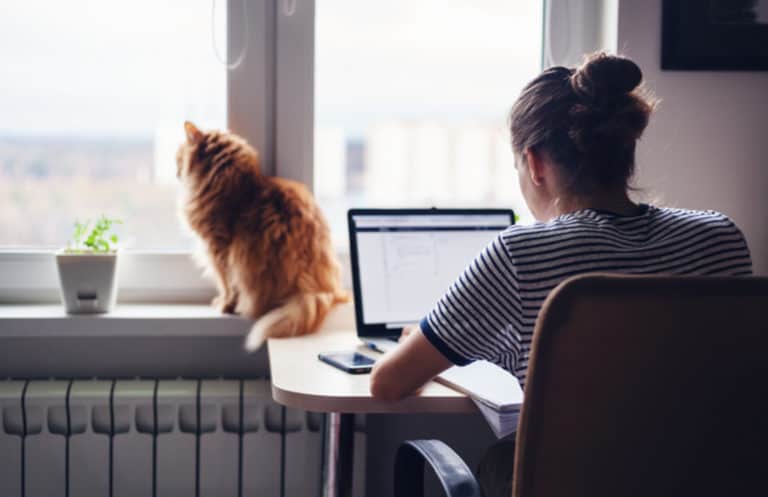
The easing of UK lockdown continues and as businesses slowly reopen, employees are returning to offices and factories. But many of us are still remote working or homeschooling too.
As we begin to get used to Covid-secure public spaces, many pubs, cinema chains, and museums found themselves unable – or unwilling – to open on the government’s chosen date of 4 July, and will instead look to do so over the coming months.
With the ‘Stay Alert’ message still in place, the coronavirus pandemic is still very much with us.
From tips for homeworking to recommendations for books and ‘virtual’ days out, read our guide to adapting to life during the pandemic.
5 tips for a healthy work-life balance when your home is your office
With nearly half of employed UK adults working from home in the week to April 23 (a month into lockdown), many will now be into their fourth month of remote working. A recent survey found that 44% of people wanted homeworking to become a permanent option post-lockdown.
If flexible homeworking becomes the new norm, the need to keep a healthy work-life balance will become increasingly important.
Here are our five top tips for staying efficient and effective when working from home:
1. Maintain a morning routine
Having a morning routine means getting up at the same time every day, showering, breakfasting, and taking the time to get into ‘work mode’.
Remember, you’d normally have a commute to ease you into the day so take some time to relax before starting work.
2. Have a designated workspace
A designated workspace will help you distinguish between your work and home life.
Ensuring the rest of the family understands that you are at work – and not to be interrupted – should help you stay focused and productive.
A separate workspace should also prevent your work encroaching into the lives of those you live with.
3. Take regular breaks
If you were in the office you’d be catching up with colleagues, attending meetings, or popping out for lunch. Now that most of that is being done virtually, you need to remember to schedule your own breaks.
Take a walk in the garden, catch-up with the rest of the household, but also try not to get distracted. Taking a break should help you refocus, not lose focus.
4. When it’s time to switch off, switch off
Maintaining a good work-life balance when working from home means knowing when your working day is over and switching off, both figuratively and physically.
Unplug your laptop, sign-out of work-related apps on your phone, and ideally hide both devices in a drawer or the cupboard under the stairs.
This removes the temptation to check on work emails and gives you time to fully relax.
5. Maintain an evening routine
A consistent evening routine is as important as a morning one.
Do whatever you need to do to relax and try to get to bed at the same time each night. This will help your body clock get used to your new working pattern and also gives you the best chance of getting the right amount of high-quality sleep.
Reader numbers soar: What to read in lockdown
The Guardian reported that 41% of people read more during April.
If lockdown has seen your to-read pile diminish, here are three award-winning books from the last year to add to your list:
1. The Nickel Boys, by Colson Whitehead
Whitehead won the 2016 Pulitzer Prize for Fiction for The Underground Railroad and followed it up with The Nickel Boys. The novel went on to win the 2020 prize.
Set in 1960s America, it follows two young boys sent to a hellish reform school in which children are routinely brutalised. The story is based on the history of a real school in Florida that operated for over 100 years.
2. Girl, Woman, Other, by Bernardine Evaristo
Evaristo, who shared the 2019 Booker Prize with Margaret Atwood, is now also the recipient of the National Book Awards, Fiction Book of the Year, for Girl, Woman, Other.
The novel follows twelve characters from the start of the twentieth century through to the birth of the twenty-first, offering a devastating portrait of modern Britain.
3. Underland, by Robert Macfarlane
Underland was Macfarlane’s fourth book to be nominated for the Wainwright Prize for Nature Writing. It took the prize last year, with the 2020 winner set to be announced at the end of next month.
In Underland, Macfarlane takes his inspiration from stories of human beings’ descent into the underworld.
From caves in the Mendips to the catacombs of Paris, these claustrophobic adventures also have something to say about our fragile relationship with landscape, time, and place.
Museums and galleries worth a visit from your sofa
In the weeks following the Prime Minister’s lockdown announcement on 23 March, you might have found yourself looking online for sources of entertainment.
Top Ten lists of ‘virtual’ museum and gallery tours appeared. As the arts and culture sector begins a tentative reopening, here are five virtual tours still worth a visit.
1. Natural History Museum
Stroll along the crowd-free corridors, allow yourself to be guided by Sir David Attenborough through the Hintze Hall, or peek behind the scenes.
With plenty of artefacts to ‘virtually’ pickup for a closer look and numerous ways to interact with the exhibits, the Natural History Museum is well worth a virtual visit.
The museum hopes to open again during the summer.
2. Tate Britain
Tate Britain, along with its sister gallery the Tate Modern, is set to reopen on July 27. When it does, it will showcase an Aubrey Beardsley exhibition and Steve McQueen’s Year 3 installation.
For now, make do with the virtual tour and take a closer look at John Singer Sargent’s Carnation, Lily, Lily, Rose, and JMW Turner’s The Shipwreck, among countless others.
3. British Museum
The website for the British Museum boasts eleven ways to explore from your sofa, including via a virtual tour, through blogs and podcasts, and by downloading resources for classrooms or homeschools.
Exhibits include a plate dating from between 520 and 510 BC and the Lewis Chessmen, found on the Isle of Lewis and thought to date from between 1150 and 1175 AD.
