

On 5 August 2024, global stock markets plunged. The Japanese Nikkei 225 closed more than 12% down, marking its largest one-day percentage drop since October 1987. The 4,451 points drop, meanwhile, was its largest ever.
This fall was felt by markets around the world, as US, European, and Asian markets all suffered.
The following day, stocks had largely recovered but the underlying worries behind the fall – a slowing US economy, Japanese interest rate rises, falling tech stock – remained.
So what do these continuous worries, and the potential for further market dips mean for our investments?
Keep reading to find out.
Market dips are an inevitable part of long-term investing and will happen again
Back in August, figures for US business growth triggered worries about an imminent American recession. Adding to concerns about interest rates and high values attached to US tech stock, figures suggested that economic growth may be slowing.
Markets hate uncertainty, which usually translates to short periods of volatility. While this was the case at the start of August, it’s important to remember that dips are to be expected.
The fall in Japanese markets might have been large, but this appears to be a short sharp shock rather than a systemic one, like we saw with Covid or the 2008 global financial crisis.
Indeed, the Nikkei recovered from its 12% drop to finish the following day 10% up.
As we said, these types of short-term dips happen all the time. Markets generally recover, and recover quickly, as the S&P 500 did in the below examples.
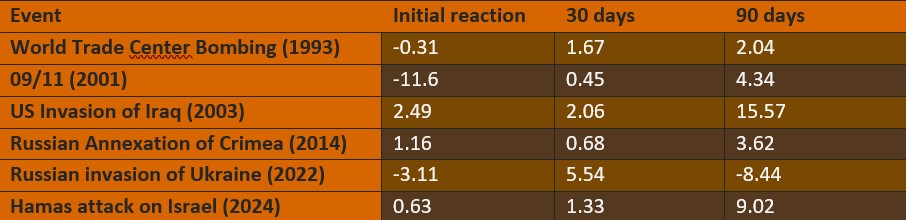
Source: Financial Wealth Management (Financial Times)
Not only have these dips occurred before, but they will also do so again.
In terms of your investments, the key is how you react (or don’t react) to what can be a worrying time.
5 important lessons to apply to your long-term investments now
1. The markets generally trend upwards
Short-term dips will occur, and past performance is no guarantee of future movements. But, generally, if you keep your money invested, your pot can be expected to grow over the long term.
This is because the general market trend is upward. Here’s the FTSE 100 over the last 40 years.
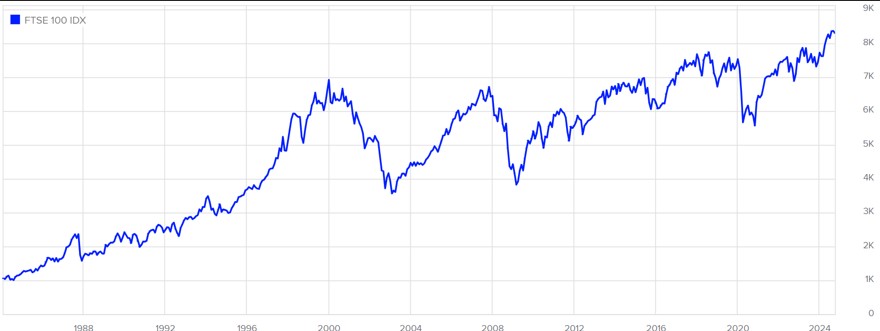
Source: Google Finance
Despite dips coinciding with global events like the Iraq War, the global financial crisis, and the coronavirus pandemic, the upward momentum is clear.
Try to remember this when market movements hit the headlines.
2. Ignore the noise and avoid emotional decision-making
Short-term volatility might be an inherent part of investing, but it can be easy to forget this.
When news and social media are filled with sensational headlines of “plunging” stocks, it’s only natural that you’ll worry about your hard-earned money. But emotional, knee-jerk reactions can be costly.
Panic-selling the stock you hold could turn a paper loss into a real one. Worse still, your money won’t be invested when markets recover, so you’ll suffer an opportunity loss too.
3. Your plan is unique to you so stay focused
Always stay focused on your long-term aims and remember that if your goals haven’t changed, it’s unlikely that your plans will need to.
Your plan is unique to you. That means it’s aligned with your goals and time frames, as well as your attitude to risk.
We can help you to manage risk. Firstly, we’ll do this by getting to know you, and your capacity for loss. Then we’ll use diversification to ensure that your portfolio aligns with your risk tolerance.
By spreading your money between asset classes, sectors, and geographical regions, it is hoped that a drop in value in one area will be offset by a rise elsewhere.
4. Avoid trend-chasing and other biases
Trend-chasing bias, or herd mentality, means making decisions based on the prevailing trend.
As with market downturns, when you see swathes of investors all piling into the same stock or sector, it can be easy to assume that it must be the right thing to do. All those people can’t be wrong, right?
Again, it’s vital to remember that your plan is unique to you. That means that what’s right for one fellow investor won’t automatically be right for you.
5. We’re here to help so you’re never on your own
Investing can be complex, and when markets fall, it can be worrying too.
Remember that we’re always on hand to help.
Speak to us if you think you’d like to make any changes to your portfolio or profile. We can help to talk you through the options available and help to ensure they’re right for you.
Get in touch
If you would like to discuss your investments or any other element of your long-term financial plans, please email enquiries@futureplanningwm.co.uk or call 01793 575553.
Please note
The value of your investments (and any income from them) can go down as well as up and you may not get back the full amount you invested. You could lose your investment. Past performance is not a reliable indicator of future performance. Levels, bases of and reliefs from taxation may be subject to change and their value depends on the individual circumstances of the investor.
This article is for information only. Please do not act based on anything you might read in this article. All contents are based on our understanding of HMRC legislation, which is subject to change.
