

As a parent or grandparent, you may be thinking about ways you can build a nest egg for children or grandchildren. It’s a step that can give them financial security as they become independent.
According to the Royal Mint’s 2021 Savings Report, 93% of parents say a savings account for their children is important. And more than 8 in 10 have already set up such an account.
The Covid-19 pandemic has pushed saving for children up the list of priorities for parents. Following economic uncertainty, 62% of parents are looking for new ways to save and invest to support their children. To reach this goal, 8 in 10 parents hope to develop better money habits.
A nest egg can help children to pursue their goals and give them some financial freedom in adulthood. The money you build up throughout their childhood could be used to help them reach important life milestones, such as going to university, learning to drive, or buying their first home.
Concerns about the future are fuelling parents to save more. Almost half (48%) said they were worried about the job security their children will have, and 47% said the housing market was a concern.
While your child or grandchild facing these challenges may seem a long way off, the steps you take now can lend them an important helping hand.
Starting a savings account for a child
A common way to save on behalf of a child is to open a savings account in their name.
The deposits you add to a child’s saving account will benefit from interest. The amount of interest paid varies between accounts, so it’s worth shopping around to help you get the most from the savings.
Individual accounts and providers may have a limit on how much you can save into a child’s savings account on a monthly, annual, or total basis.
There are several different options to find an account that suits your needs. An easy-access account means you can make withdrawals whenever you like. This can be useful if you want to use the money before they reach adulthood or as a way to teach children about money. In contrast, a fixedterm child’s saving account will lock the money away for a defined period, but will typically offer a higher rate of interest.
Setting out how much you want to deposit and your goal for the account can help you choose the right option for you.
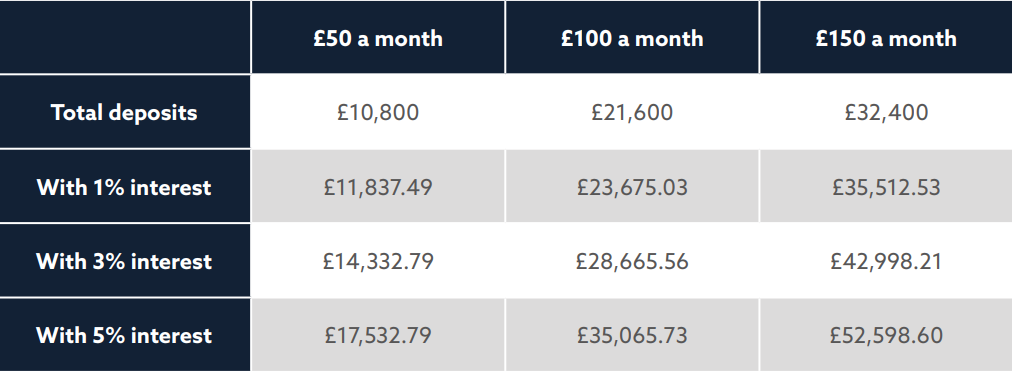
You may have a lump sum you want to use to kickstart the nest egg, but whether you do or will be starting from scratch, regular contributions can add up to more than you think. The below table highlights how monthly contributions can lead to a nest egg if you save from birth until the child is 18, as well as the impact of interest rates, assuming you don’t make any withdrawals.
Source: Money Saving Expert
Are you missing out by saving in your name?
Almost a fifth of parents or guardians saving for their child do so by putting money away in their own bank account. While this can give you more control, you’re probably missing out – children’s savings accounts usually offer a higher interest rate than adult savings accounts.
Junior ISAs: A tax-efficient way to save for children
Junior ISAs (JISAs) were introduced in November 2011 and provide parents with a tax-efficient way to save and invest for their children under 18. Over the last decade, they’ve become a popular way to build a nest egg.
For the 2021/22 tax year, you can place up to £9,000 into a JISA. This limit will remain the same for the 2022/23 tax year.
The latest government figures show that during the 2019/20 tax year, around 1 million JISA accounts were subscribed to. During 2019/20, £971 million was added to JISAs with an average subscription of £5,240. Around 6 in 10 JISAs are Cash JISAs.
There are two key benefits to choosing a JISA:
- All the money is tax-free. No tax will be due on the interest earned or returns if you choose to invest through a JISA. While rare, children can be liable for tax, and there are strict rules in place to stop parents from using a child’s tax-free allowance to reduce their own tax bill.
- Interest rates are likely to be higher. Often, JISA interest rates are higher than adult ISAs and children’s savings accounts. Choosing a JISA as a way to save can increase how much your deposits earn.
Of course, there are drawbacks to consider too. You won’t be able to withdraw the money placed in a JISA until the child is 18, so if you want flexibility, it may not be the right option for you. Once they turn 18, the money saved will belong to the child and they can use it however they wish.
In some cases, you may be worried that reckless spending could mean your savings don’t create the financial security you’d hoped. Having a conversation with teenagers about what the money is intended for can help provide them with some direction, but, ultimately, they’ll be in control of the money saved through a JISA. If you have concerns, a trust could make sense.
Does your child have a Child Trust Fund?
If your child was born between 1 September 2002 and 2 January 2011, they will have a Child Trust Fund. This was set up automatically by the government and will include at least an initial contribution. You can continue to add to a Child Trust Fund or transfer the money to a JISA.
If you’ve lost the details of a Child Trust Fund, HMRC can help you track it down.
Trusts: Why they can be useful for passing assets on to children
Trusts are used to set assets aside, from cash to shares, for beneficiaries. In some cases, they can be a useful way to pass on assets to children. With a trust, you’re able to set out certain conditions – for instance, you may decide that your child can only access the assets once they turn 25. If you want more control over how and when the assets can be used, a trust can provide this. However, they can be complex and irreversible once set up, so it’s advisable that you seek advice.
Are Premium Bonds a good option for children?
Premium Bonds are a different way to save, and you can purchase them on behalf of a child. You can place between £25 and £50,000 in Premium Bonds for children aged under 16. The money you place in Premium Bonds is safe and can be withdrawn at any time. However, unlike a savings account, your deposits won’t earn interest. Instead, each month, Premium Bonds are entered into a prize draw and can win prizes between £25 and £1 million. It can make saving exciting, but keep in mind that this isn’t guaranteed.
Investing: When does it make sense to invest a nest egg?
While saving for your child may seem like the “safe” option, inflation means savings can fall in value in real terms. As the cost of living rises, the savings need to grow by the same rate to maintain spending power. After more than a decade of low-interest rates, it’s unlikely savings accounts have delivered the interest needed to remain the same or grow in real terms.
Let’s say your child was born in 2002 and you had a £10,000 lump sum to put away for their 18th birthday. To have the same spending power in 2020, that money will need to have grown to £16,636.46, according to the Bank of England’s inflation calculator.
If you’re saving for short-term goals, a savings account often makes sense. However, when you’re saving with a longer time frame in mind, investing should be considered. Investing does present some risks, but it also provides an opportunity for the money you’re putting away to grow more.
If you haven’t considered investing on behalf of your child, you’re not alone. Around 4 in 5 parents saving for children are doing so exclusively in cash, according to an Independent report.
So, when should you consider investing? If you plan to build up a nest egg over five years or more, investing is something you should think about. As you’re saving for your child’s future, it’s natural to be worried about investment risks. Creating a balanced portfolio that reflects your risk profile and circumstances can provide peace of mind, and we’re here to help you.
As well as risk, a Royal Mint report found that 40% of parents did not understand the logistics of how to invest. The same proportion also said they were worried about being scammed. Working with a financial planner to organise your finances and create a long-term plan that considers your children or grandchildren can help you understand how to invest and means you have someone to turn to if you have any questions.
Despite JISAs often being used as a long-term way to save for a child’s future, just 39% of JISAs are invested. If the money won’t be accessed for five years or more, it’s worth considering a Stocks and Shares JISA.
Source: Gov.uk
If you want to start investing on behalf of your child, a JISA is a good place to start. As with a Cash JISA, you can place up to £9,000 for the 2021/22 tax year into a Stocks and Shares JISA and your child will be able to access the money when they turn 18. Investment returns are tax-free and go on to be invested themselves so they can benefit from the effects of compounding.
There are many different types of investments that can be held in a Stocks and Shares JISA, allowing you to create a portfolio that suits your risk profile. interactive investor revealed how their customers choose to invest through JISAs:
- Investment funds (45%)
- Equities (20%)
- Investment trusts (13%)
- Cash (13%)
- Exchange-traded products (8%)
Of course, investment returns can’t be guaranteed, and it’s important to note that the value of your investments can fall. Investments will experience short-term volatility; this is why you should only invest with a long-term outlook. Investing for a longer period provides more time for the peaks and troughs to smooth out.
5 quick tips to build a nest egg
- Start early. It’s never too early to start saving or investing on behalf of your child. Putting money away sooner means it has longer to benefit from interest or returns.
- Shop around for the best interest rates. If you choose to save, make sure you shop around to find the best interest rate available. The interest rate can have a huge impact on how the savings grow.
- Make consistent contributions. Research published in FTAdviser shows that while 60% of parents save or invest for their newborns, the figure falls to 54% by the time the child reaches secondary school. So, keep making consistent deposits to reach your goal.
- Consider investing for long-term goals. If the money won’t be accessed for five years or more, investing can make sense. Take some time to explore your options before simply putting the money in a savings account.
- Involve family and friends. If family or friends ask what your child would like for their birthday, a deposit into their JISA can have a much bigger impact than the latest toy. Grandparents or others may also want to make regular contributions to the nest egg you’re building up.
Thinking long-term: Setting up a pension
While your child may not yet be at school, did you know you can open a pension for them? Retirement will be decades away, but starting a pension now can create long-term financial security.
For the 2021/22 tax year, you can pay up to £2,880 into a pension for someone that is not earning an income, including children. Your deposits will benefit from 20% pension tax relief. So, if you deposit the maximum amount, tax relief of £720 will boost the total to £3,600.
Usually, pension contributions are invested. As a pension will not be accessible for decades, there’s huge potential for growth due to the benefit of compounding. Paying into a pension throughout childhood can provide an excellent foundation for retirement savings that they can add to once they start earning an income.
Research from AJ Bell shows how pension contributions in childhood can add up. If you contribute the maximum into their pension from birth to the age of 18, the findings suggest they could have £1 million in their pension when they are 71, without having to make additional contributions when they’re an adult.
Over the first 18 years, you’d have contributed £51,840 to reach this milestone. The calculations assume an annual real investment growth rate of 4.5% post charges. This rate of return cannot be guaranteed but the results demonstrate the power of compounding.
There are things to keep in mind if you plan to open a pension on behalf of a child.
- The money won’t be accessible until they reach pension age. As a result, it’s not a flexible option if they want to use the money for other things, like a deposit on a home.
- Pension rules can change. At the moment, you can access your pension at 55, rising to 57 in 2028, and it’s expected to rise further. The tax benefits of pensions and other rules could change too.
Making your family part of your financial plan
When setting out your financial plan, your priorities are crucial. For families, ensuring their children and grandchildren will be secure is often important and we can help you build a financial plan that reflects this.
It’s not just a nest egg that’s important either. We can help you take steps that could provide your family with security, from setting out an estate plan to taking out financial protection in case the unexpected happens.
If you’d like to discuss how to create long-term financial security for your child or grandchild, please contact us
